Right now
What the Roman archive at MAST and the pipeline's calibration files hold, checked by this server on a timer. Pick a figure for the detail.
The observatory, module by module
Roman is a 2.4-metre telescope feeding two instruments: a wide-field infrared camera that does the mission's survey science, and a coronagraph that tests how to photograph planets next to their stars. Pick a part of the drawing, or a card, to see what it does and how it is built. Numbers are from NASA, STScI and IPAC pages, linked on each card.
The surveys the instruments are built for
Further reading
Official pages, checked to load when this section was written.
Four steps
Nothing to install: the portal runs here, in your browser. Accounts are free and approved by hand.
Tell us who you are and what you'd like to use it for.
Click the link we send you. Your request then goes to the portal's admin, and you get an email with the decision.
On the sign-in page, enter your email; we send a one-time link. No password. A sign-in lasts a day.
The first visit after a quiet spell starts the server, which takes a minute or two; the page shows progress and tells you when it's ready.
What the portal has
Everything below is in the running app behind the button above. Each card links to the how-to that explains it, for beginners, astronomers and developers.
Timeline
One line per thing that happened: the NASA Roman blog as the server fetches it, the commissioning log kept in milestones.json, calibration references that arrive from orbit, and changes the archive watch notices. Newest first.
One exposure, eighteen detectors
The first light, 15 September 2026, before focusing. Hover a detector; they are laid out as the portal's focal-plane overview shows them.
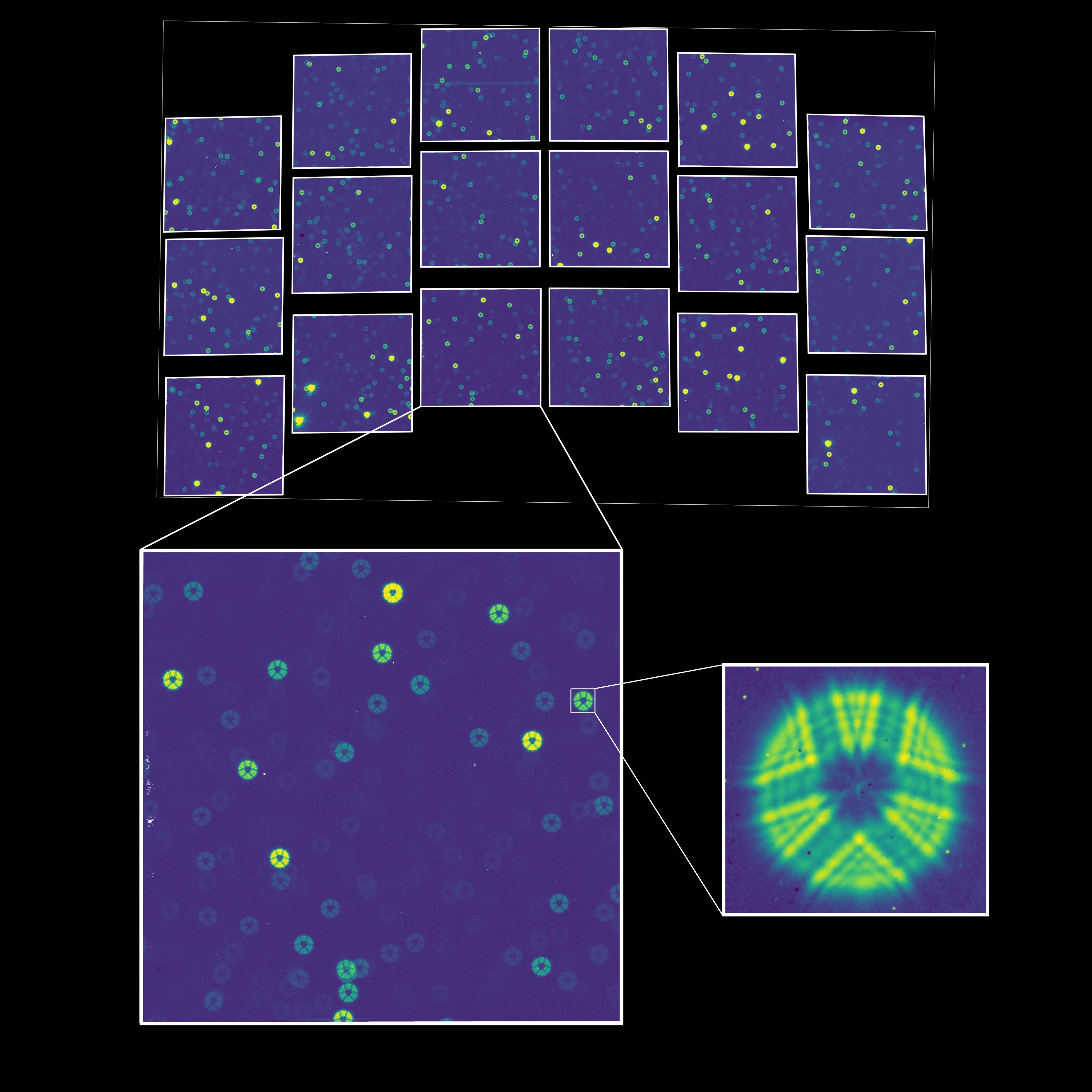 NASA/GSFC
Gallery
Pictures from the mission and from the portal itself. NASA images are public domain; the credits are in each caption.
Documentation
Written for three readers at once: someone new to astronomy, an astronomer new to Roman, and a romancal developer. Press ⌘K anywhere on this page to search it and the guide.
About the clock. The launch time is fact. L2 arrival (after what NASA calls a "three-month journey") and first images ("by early 2027") are NASA's public estimates, and the distance figure assumes uniform progress along the route, which a real trajectory does not. All three dates are settings (ROMAN_PORTAL_LAUNCH_TIME, ROMAN_PORTAL_L2_ARRIVAL_TIME, ROMAN_PORTAL_FIRST_IMAGES_TIME); update them as NASA firms up the schedule. Until then, everything in the default dataset is simulated.